

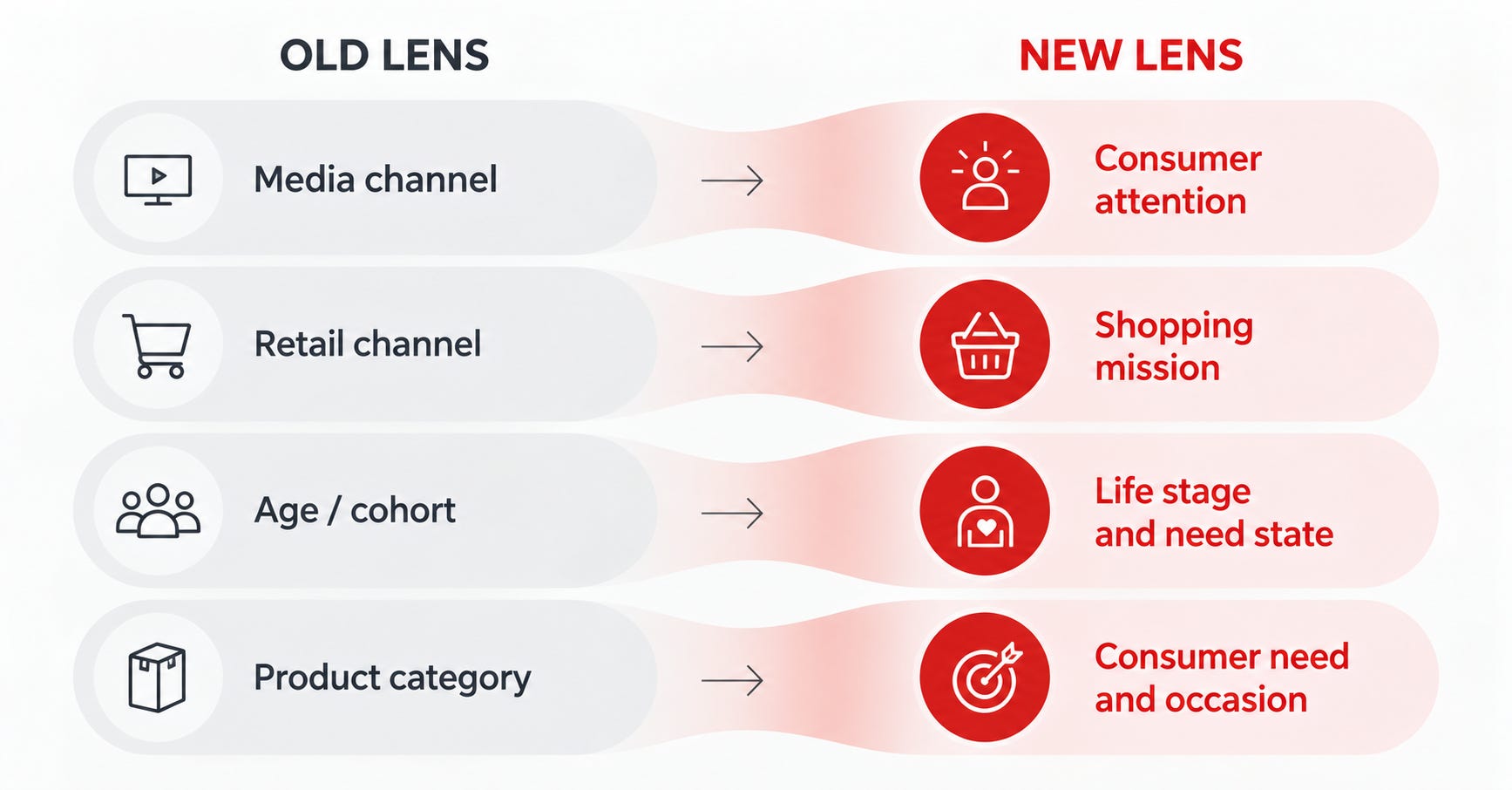
Companies must come to terms with the cumulative blurring that has taken place and organize accordingly.
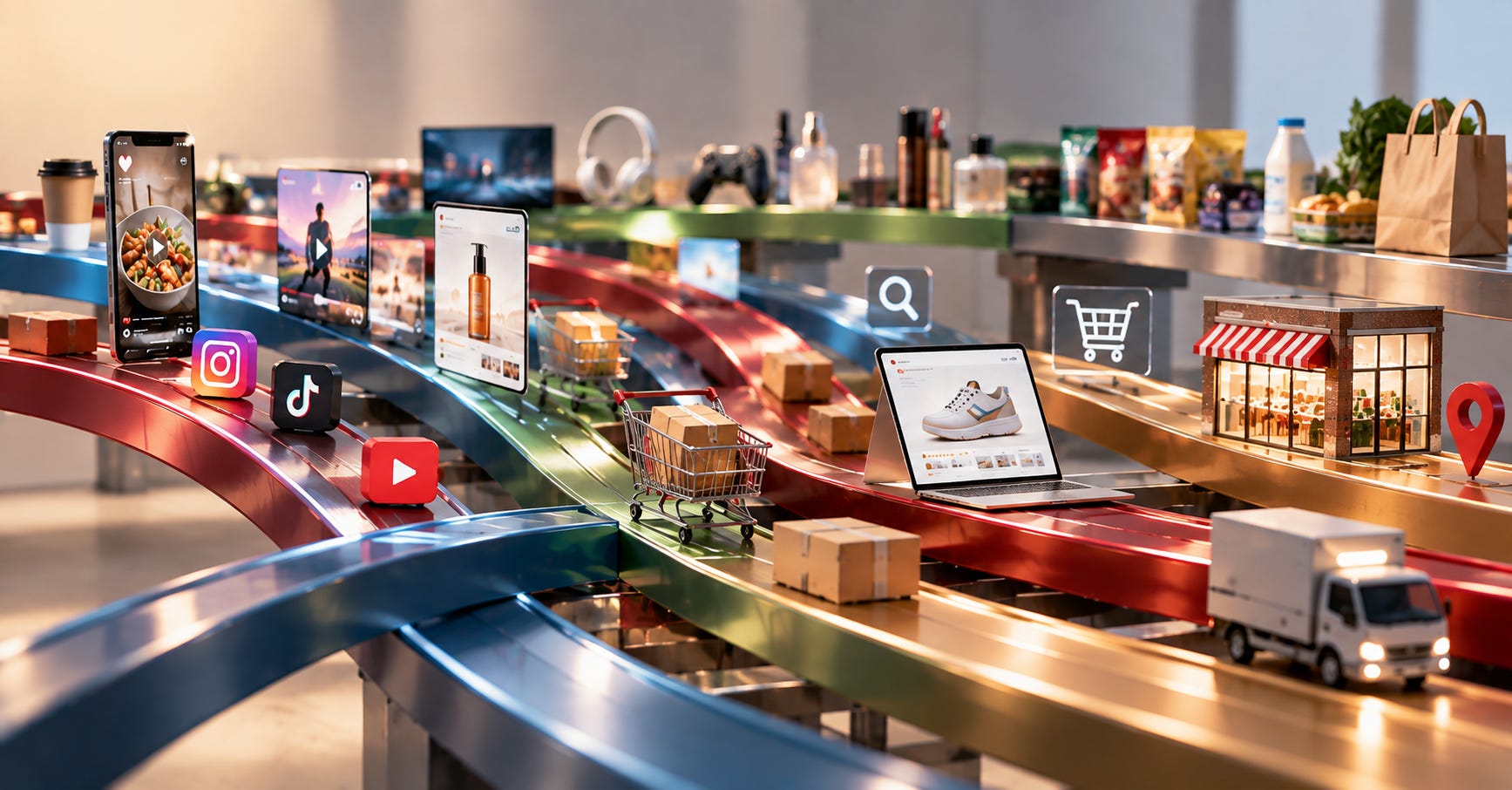

Four boundaries are disappearing. The way CPG companies organize around them needs to change too.
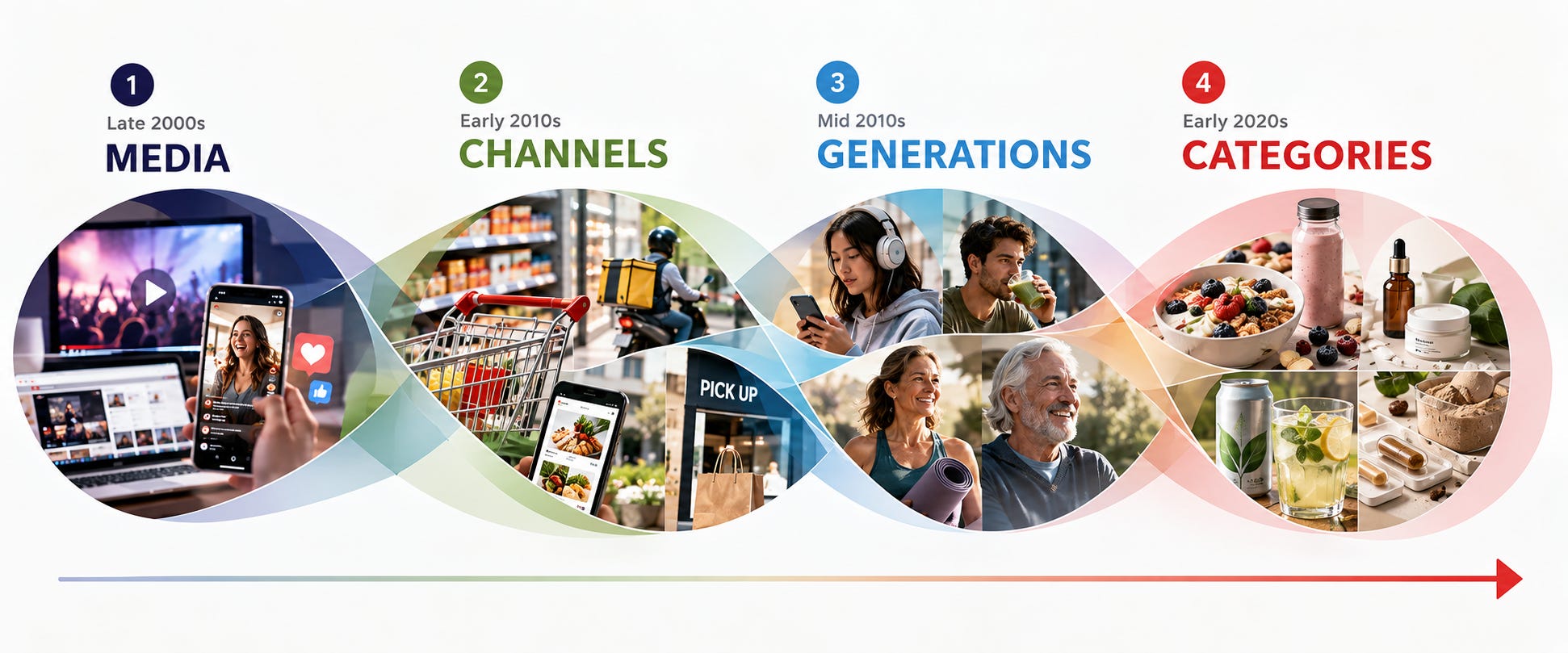

The boundary that blurred: Media → Commerce
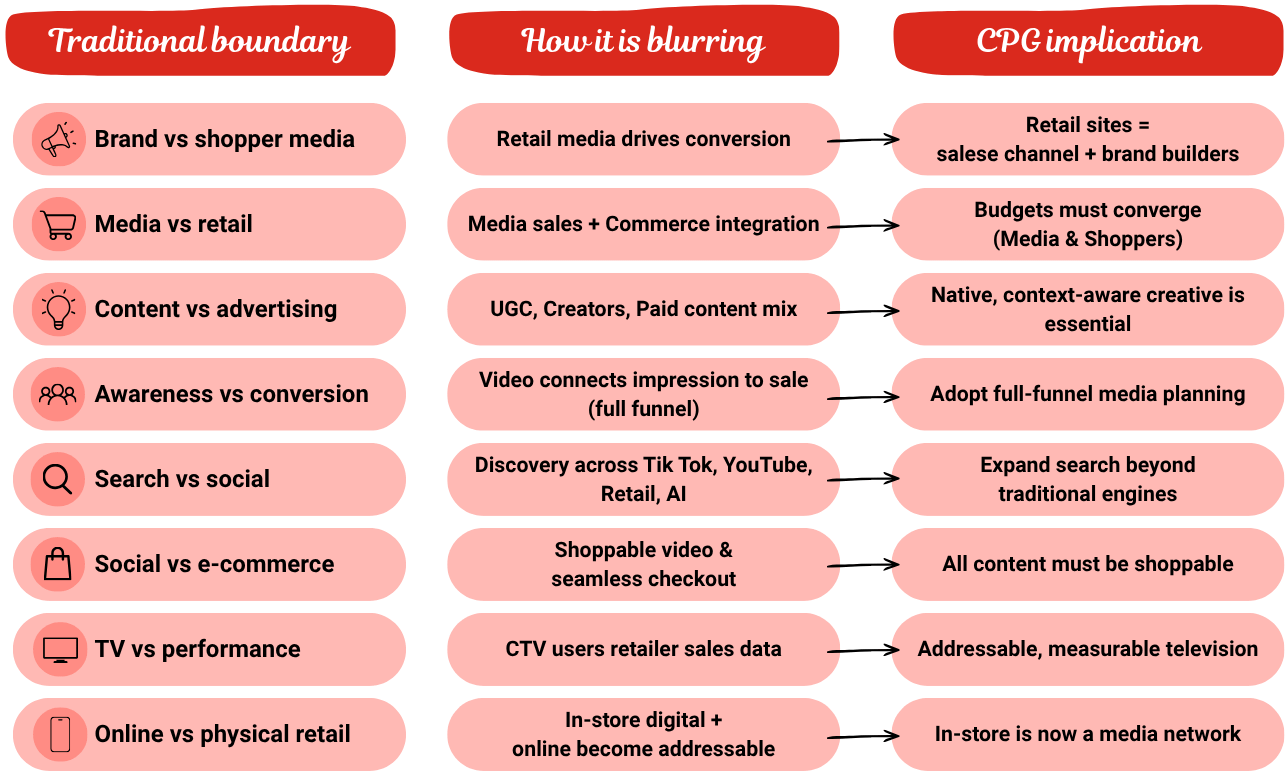
Consumer attention is fragmenting while media capabilities are converging. Retailers increasingly act like media platforms, and media platforms increasingly enable discovery, recommendation and transaction.
Retailer first-party data has become a media asset: Retailers know what consumers actually buy, making their audiences valuable for targeting and closed-loop measurement.
Media platforms are adding commerce: Social and content platforms increasingly integrate product discovery, affiliate models, shopping and checkout.
Consumer journeys have fragmented: Discovery can start with creators, retailer search, video, reviews, social trends, marketplaces or AI - and purchase may happen elsewhere.
AI is compressing the journey further: AI-driven search, recommendation and agentic commerce can combine discovery, evaluation and transaction in a single interface.
What it means?
Media blurring is the erosion of the traditional boundaries between brand media, shopper media, retail, content, entertainment, search and commerce.
Consumers can now discover a product, see creator content, research it, receive recommendations and purchase it within the same or closely connected environments.
The challenges
The consumer experiences one connected journey - see -> discover -> investigate -> validate -> shop -> buy -> advocate - while many CPG organizations still manage it through separate functions and budgets, underestimating how the model has changed.
Budget ownership becomes ambiguous: a retailer CTV campaign may simultaneously be media, e-commerce, shopper and customer marketing.
Measurement becomes inconsistent: reach, attention, brand lift, ROAS, incrementality, new-to-brand and retailer sales measure different parts of the same journey.
Creative operating models struggle: one master TV asset is not enough for creators, social, retail PDPs, search, shoppable video, CTV and in-store screens.
How to realign
Plan around audiences and journeys, not channels - Start with who needs to change, what behavior is required and where influence can occur; select channels afterwards.
Integrate investment governance - Brand, shopper, e-commerce and customer budgets need a common decision process even if accounting ownership remains separate.
Create one cross-functional growth planning process - Brand, media, sales/customer, e-commerce and insights should jointly define audience, occasions, growth objective, investment and measurement.
Create a common measurement hierarchy: Use business outcomes (incremental sales, penetration, margin), consumer outcomes (trial, repeat, consideration), media outcomes (incremental reach, attention) and commerce diagnostics (conversion, new-to-brand, basket).


The boundary that blurred: Physical → Digital
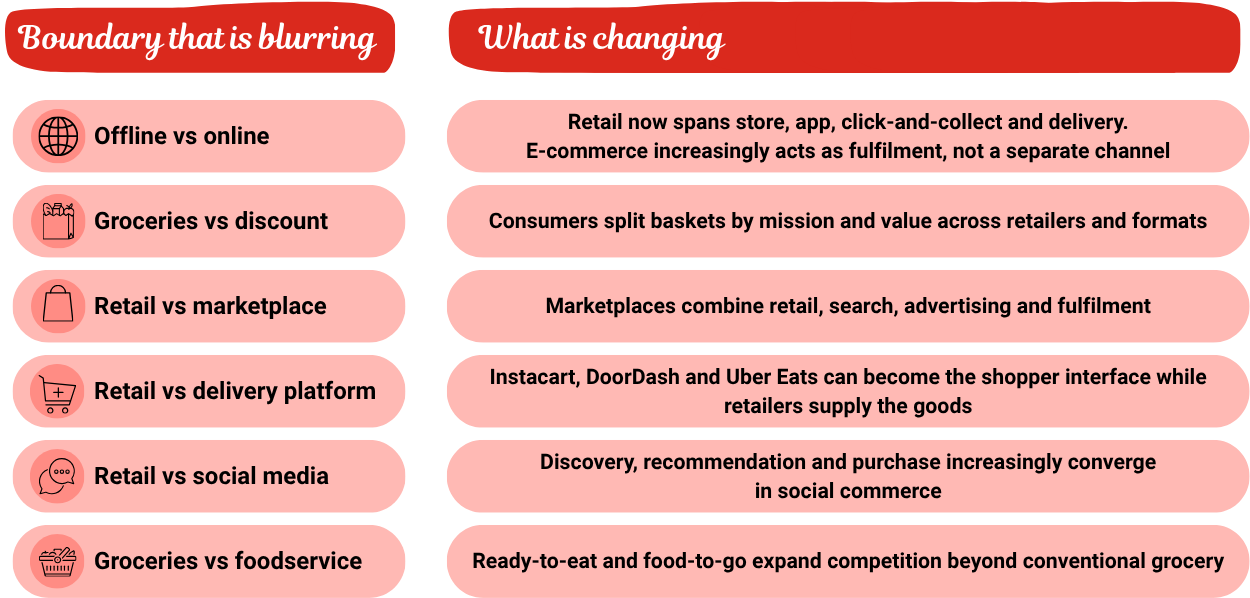
Consumers increasingly assemble their shopping journey around need, occasion, value, convenience and fulfilment rather than a single retail channel. For CPG companies, the strategic response is not simply “more e-commerce”; it is to manage demand, assortment, price-pack architecture and availability across an increasingly fluid omnichannel ecosystem.
What it means?
Availability becomes strategic. When shoppers can switch retailer or platform quickly, out-of-stock increasingly risks becoming a competitor purchase rather than a delayed purchase.
Category and competitive sets expand. A lunch product may compete across supermarket food-to-go, convenience, QSR, cafes, delivery and ready meals.
Assortment boundaries weaken. “Channel-exclusive” products can surface through marketplaces, delivery intermediaries or resale, while the same store inventory may serve both digital and physical shoppers.
The challenges
Convenience and time optimization. Consumers increasingly choose the lowest-friction route to fulfil a need: store, pickup, delivery, subscription or rapid commerce.
Digitization of physical retail. Apps, loyalty programs, digital payments, inventory visibility and in-store technology connect physical stores to digital journeys.
Changing consumption occasions. Growth in convenience, ready-to-eat and food-to-go erodes the traditional separation between grocery and foodservice.
Value pressure. Inflation and pressure on disposable income encourage basket splitting, price comparison, discounter/club usage and private-label switching.

How to realign
The strategic question moves from “How do we win in supermarkets / Amazon / discounters?” to “How do we win the consumer occasion wherever discovery, shopping and fulfilment happen?”.
Make availability and fulfilment a competitive capability. Improve digital shelf availability, inventory visibility, forecasting and service levels because switching costs for consumers are increasingly low.
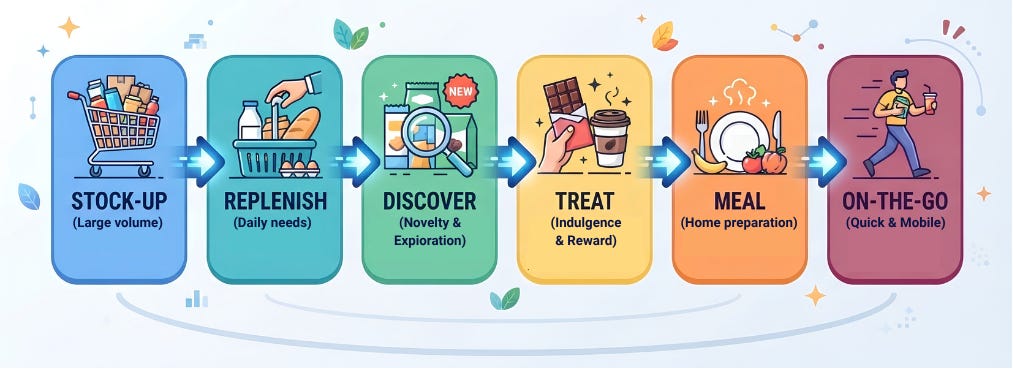
Move from channel strategy to shopping-mission strategy. Plan around stock-up, replenishment, immediate need, discovery, treat, meal solution and on-the-go missions; then identify which channels compete for each mission.
Give channels differentiated roles. Use channel-specific pack, assortment and innovation roles: e.g., bulk/value in club, immediacy in convenience, discovery in social commerce
Build genuinely omnichannel consumer measurement. Track the hierarchy from total consumer/category to shopper, mission/occasion, retailer/platform, fulfilment method and SKU - rather than relying on isolated channel shares

The boundary that blurred: Age → Need state
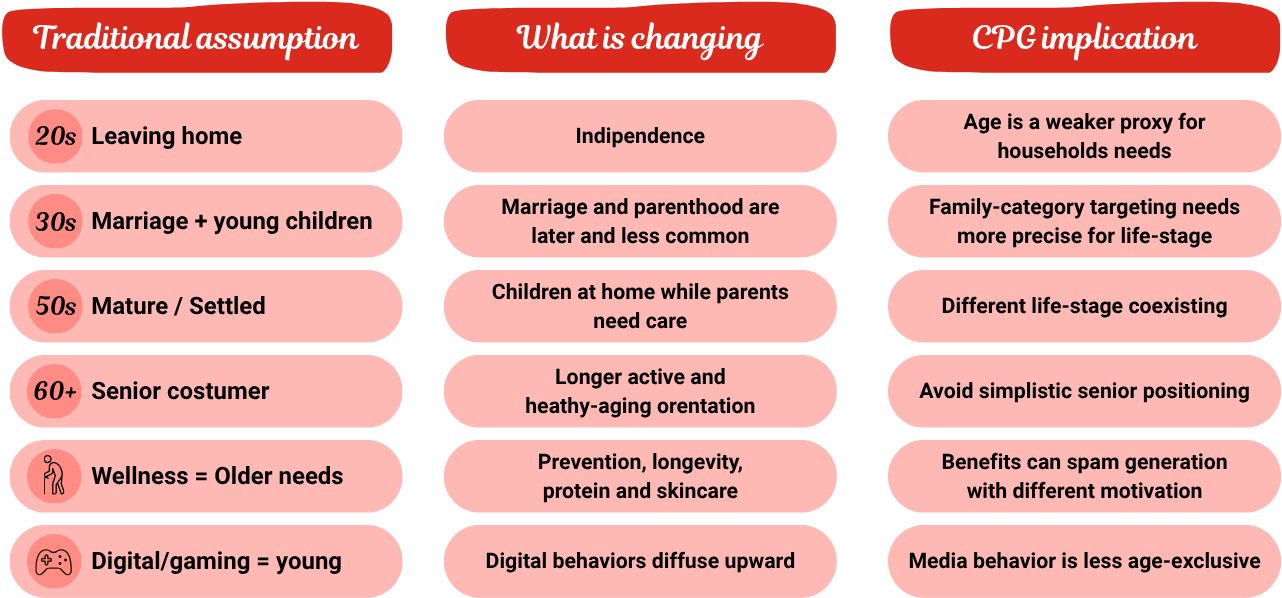
Generations are not becoming identical. What is weakening is the historical link between chronological age, life stage, household structure and predictable consumption. CPG segmentation therefore needs to move beyond age cohorts toward life stage, need state, attitude and occasion.
What it means?
Needs move across age boundaries. Healthy aging, protein, cognition, sleep, gut health and preventive skincare are increasingly relevant before traditional “mature” life stages. Conversely, digital shopping, social discovery, gaming and experimentation are no longer exclusive to younger consumers.
Households contain multiple generations and need states. One basket may serve children, young adults, mid-life caregivers and elderly parents. The buyer, user and influencer may be different people, weakening a single “household life stage” label.
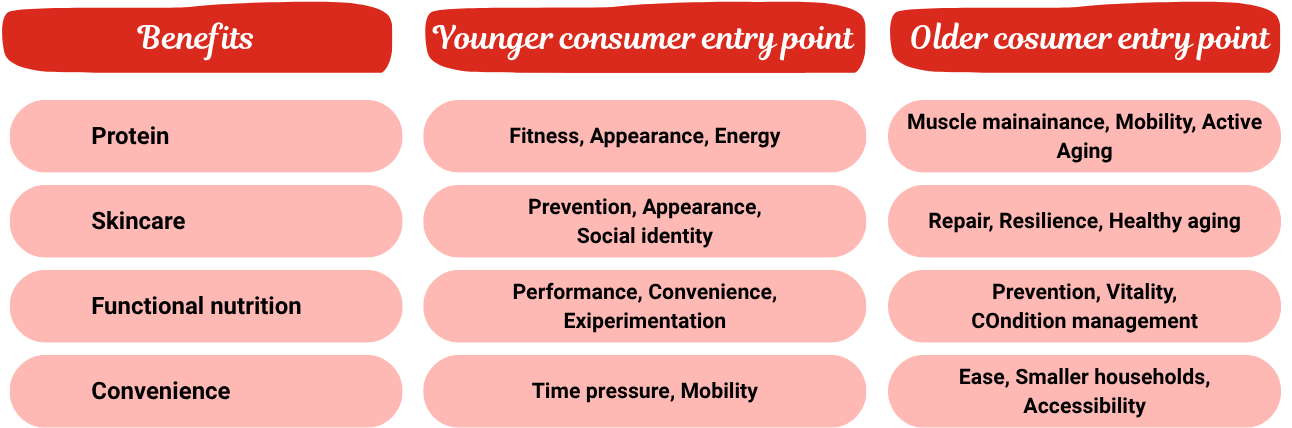
The same benefit has different jobs-to-be-done. For example:
The challenges
Consumers increasingly refuse to behave according to the neat organizational boxes CPG companies used in the past. The strategic shift is from “Who is this consumer by age?” to “What is happening in this consumer’s life, and what job are they trying to accomplish?”
Household composition, income, attitudes and needs can differentiate same-age consumers more than birth year.
Marriage, children, home ownership and retirement no longer follow one timetable
Consumers spend more years working, exercising, travelling and consuming before traditional old age.
Consumers address sleep, cognition, muscle, skin and longevity before age-triggered problems emerge.
How to realign
Segmentation: generation should remain an explanatory variable, not automatically the primary segmentation architecture.
Innovation: design around needs and jobs-to-be-done rather than age labels - e.g., longevity, energy, muscle health, sleep or convenience.
Branding: build cross-generational brands with a common benefit and different entry points, rather than defaulting to separate age-specific brands.
Portfolio: move beyond Baby / Family / Adult / Senior toward need platforms such as Nutrition, Performance, Prevention, Convenience and Healthy Aging.
Media & commerce: target behaviors, occasions and needs while avoiding assumptions that a channel or platform belongs to a single generation.

The boundary that blurred: Category → Consumer need
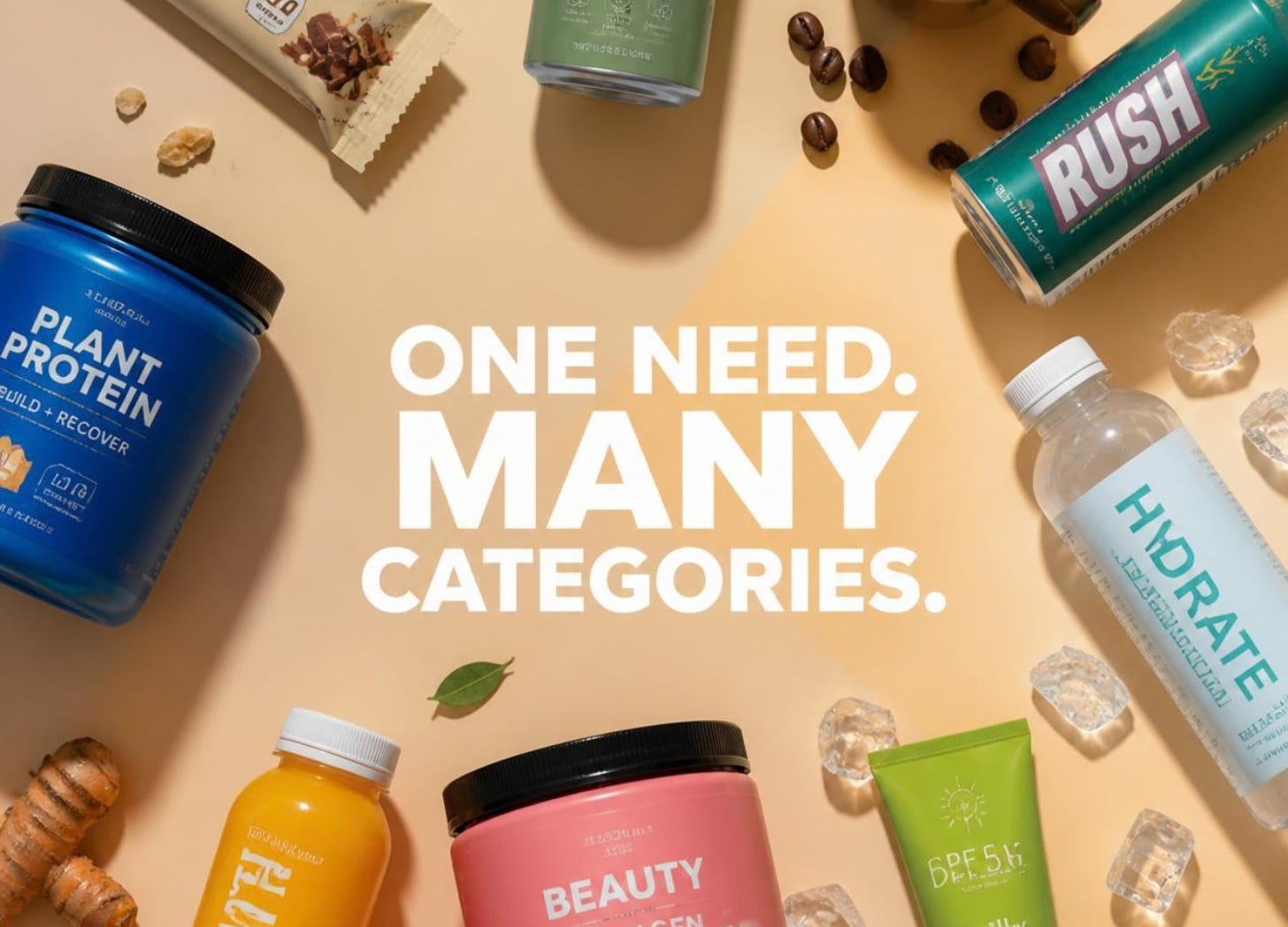
Consumers increasingly organize choices around needs, occasions and desired benefits rather than the category definitions used by manufacturers and retailers.
As a result, products from historically separate categories increasingly compete for the same demand: snacks become meals, foods become supplements, beverages deliver nutrition and wellness, and beauty expands into ingestible wellness.
The strategic shift is from managing only category share toward understanding and winning consumer demand spaces.
What it means?
Consumers don’t think (any more) in terms of “categories” but what drives their product and brand choices are increasingly outcomes that match moods and occasions that can vary throughout a day, week or month
They consider a large range of solutions and options that can be located in diverse parts of a store.
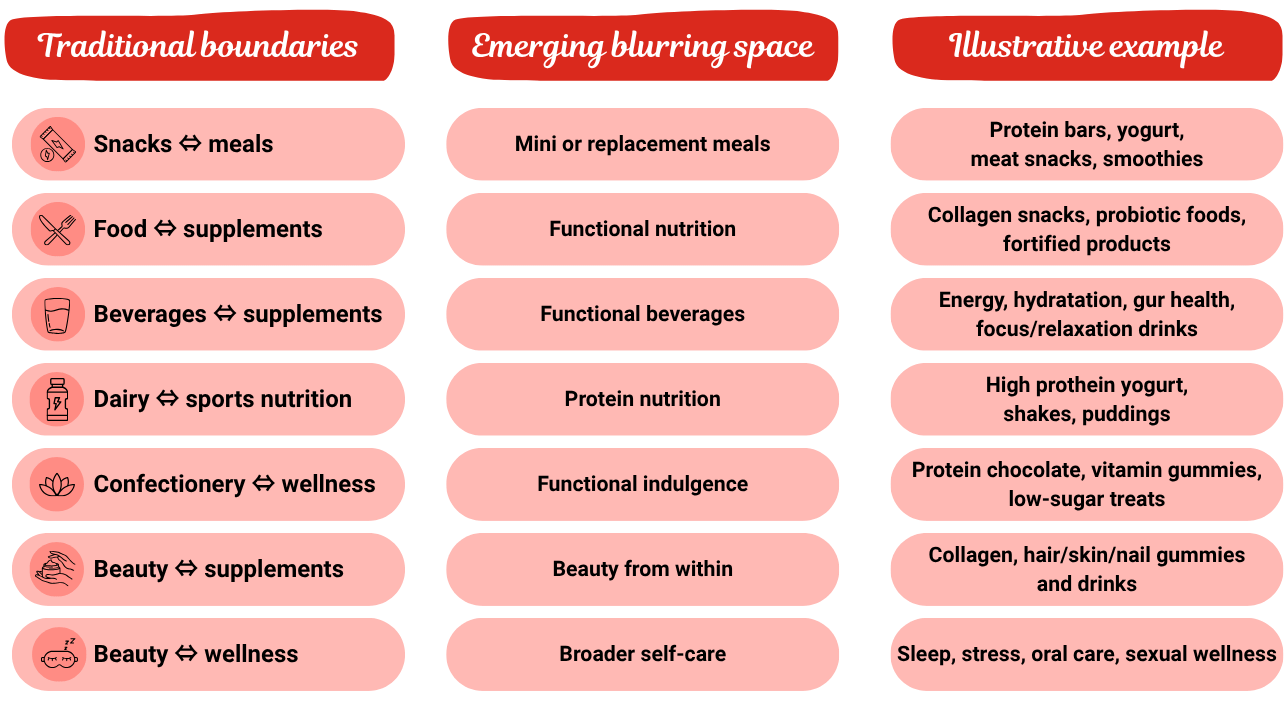
Category blurring expands both the competitive threat and the growth opportunity. Companies that define themselves only by the category they currently sell risk missing where consumer demand is moving; companies that understand the needs they have permission to serve can identify a broader addressable market.
The challenges
Boundaries have come down
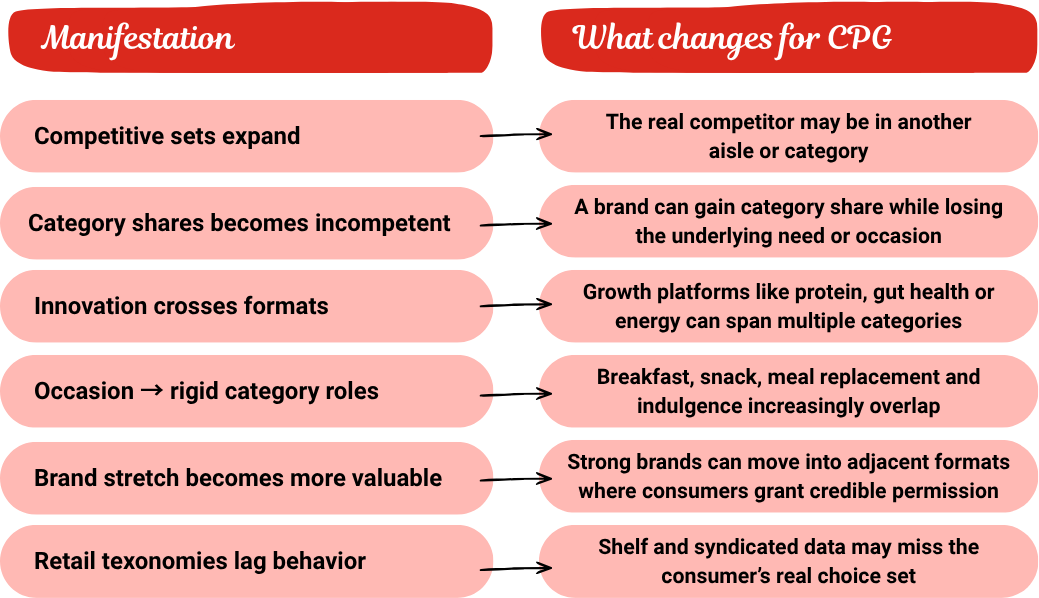
As a consequence:
Benefit-centered shopping: search, social and digital discovery encourage consumers to start with needs rather than with a conventional category.
Social-media discovery: consumers encounter benefit territories and trends rather than retailer category taxonomies, accelerating cross-category consideration.
Convenience and flexible eating: less rigid meal structures create demand for portable products that can operate as snacks, mini-meals and meal replacements.
Changing nutrition patterns, including GLP-1 adoption: demand for smaller, nutrient-dense and protein-rich products can further weaken conventional meal and category boundaries
.
How to realign
Move from category to demand-space strategy: Keep categories for reporting and execution, but add a strategic lens based on consumer needs and occasions: morning nutrition, hydration, energy/focus, gut health, healthy snacking, on-the-go meals, indulgence and relaxation.
Measure “share of need” alongside category share: Complement traditional value share, volume share, penetration and frequency with share of occasion, benefit, need and consumer expenditure.
Build cross-category competitive maps: For each priority need, map occasions, products, categories, brands and price points. For energy, for example, the relevant set can include coffee, energy drinks, functional water, shots, supplements and bars.
Organize innovation around platforms: Develop growth platforms such as protein, gut health, hydration, healthy aging, mood/relaxation and indulgence, then select the best product formats rather than limiting innovation to existing category pipelines.
Assess brand permission to stretch: Prioritize adjacencies using consumer-need attractiveness, brand permission, capability fit, channel fit and economics. Category adjacency alone is not enough.
Summary
Organizations need to evolve to operate and succeed in an irreversibly blurred CPG competitive context.
How Sevendots can help
Over the last 15 years Sevendots has supported a broad range of CPG companies to FOCUS in addressing the challenges of a rapidly evolving and blurring competitive scenario. This has been achieved through:
Strategic frameworks
Organizational alignment
Growth strategies
New business KPIs
Free readers get our latest thinking on CPG growth. Paid subscribers get the frameworks, case studies, and tools to put that thinking into action.
→ Become a Growth Builders subscriber

Sources:
1. P&G, 2026 Annual Report - Integrated Growth Strategy: https://origprod-eus2-us.pg.com/annualreport2026/pg-integrated-growth-strategy/
2. IAB Europe, Attitudes to Retail Media Report 2025: https://iabeurope.eu/knowledge_hub/iab-europes-attitudes-to-retail-media-report-2025/
3. The Trade Desk, Unilever/WPP retail-data case: https://www.thetradedesk.com/resources/how-unilever-and-wpp-unite-turned-retail-data-into-a-full-funnel-breakthrough
4. Walmart Connect, Chobani case: https://www.walmartconnect.com/resources/case-studies/2024/chobani-customer-insights-omnichannel-ads
5. Sensor Tower, Retail Media Digital Advertising in 2025: https://sensortower.com/blog/retail-media-digital-advertising-in-2025-a-year-in-review
6. NIQ (2025), From insight to innovation: how to act on key omnichannel trends: https://nielseniq.com/global/en/insights/analysis/2025/from-insight-to-innovation-how-to-act-on-key-omnichannel-trends/
7. NIQ (2025), 5 key trends in omnichannel shopping: https://nielseniq.com/global/en/insights/analysis/2025/5-key-trends-in-omnichannel-shopping/
8. Circana (2025), Unlock omnigrowth in times of uncertainty: https://www.circana.com/post/unlock-omnigrowth-in-times-of-uncertainty
9. Circana (2025), Consumers shop at 39 unique retailers a year: https://www.circana.com/post/consumers-shop-at-39-unique-retailers-a-year-focusing-on-convenience-and-value-reports-circana
10. McKinsey (2026), State of Grocery Europe: https://www.mckinsey.com/industries/retail/our-insights/state-of-grocery-europe-report
11. Deloitte, CPG omnichannel marketing strategy and capabilities: https://www2.deloitte.com/us/en/pages/consulting/articles/cpg-omnichannel-marketing-strategy-and-capabilities.html
12. Ipsos, Generations Report 2026 - Modern Milestones: https://ipsos-insight-llc.foleon.com/ipsos-thinks/ipsos-generations-report-2026/modern-milestones
13. McKinsey, Future of Wellness Trends: https://www.mckinsey.com/industries/consumer-packaged-goods/our-insights/future-of-wellness-trends
14. NIQ, The New Rules of Relevance - 2026 predictions: https://nielseniq.com/global/en/insights/report/2026/the-new-rules-of-relevance-eight-predictions-that-will-redefine-cpg-growth-in-a-rapidly-shifting-marketplace/
15. Circana, US consumer behavior and shopping trends by generation: https://www.circana.com/insights-hub/u-s-consumer-behavior-and-shopping-trends-by-generation
16. NIQ (2025), “Blurring wellness boundaries: when supplements meet food and beverage: https://nielseniq.com/global/en/insights/analysis/2025/blurring-wellness-boundaries-when-supplements-meet-food-and-beverage/
17. Circana, “From Snackification to Indulgence: A Look at the Biggest Trends in Snacking”: https://www.circana.com/post/from-snackification-to-indulgence-a-look-at-the-biggest-trends-in-snacking
18. Circana, “How Selective Consumption Is Shifting the Snackscape”: https://www.circana.com/post/how-selective-consumption-is-shifting-the-snackscape
19. McKinsey, “The Future of Wellness”: https://www.mckinsey.com/industries/consumer-packaged-goods/our-insights/future-of-wellness-trends